Forest App vs. Sip & Scroll: Gamification vs. Gentle Friction
Two apps. Two philosophies. One question: which one actually changes how you use your phone?
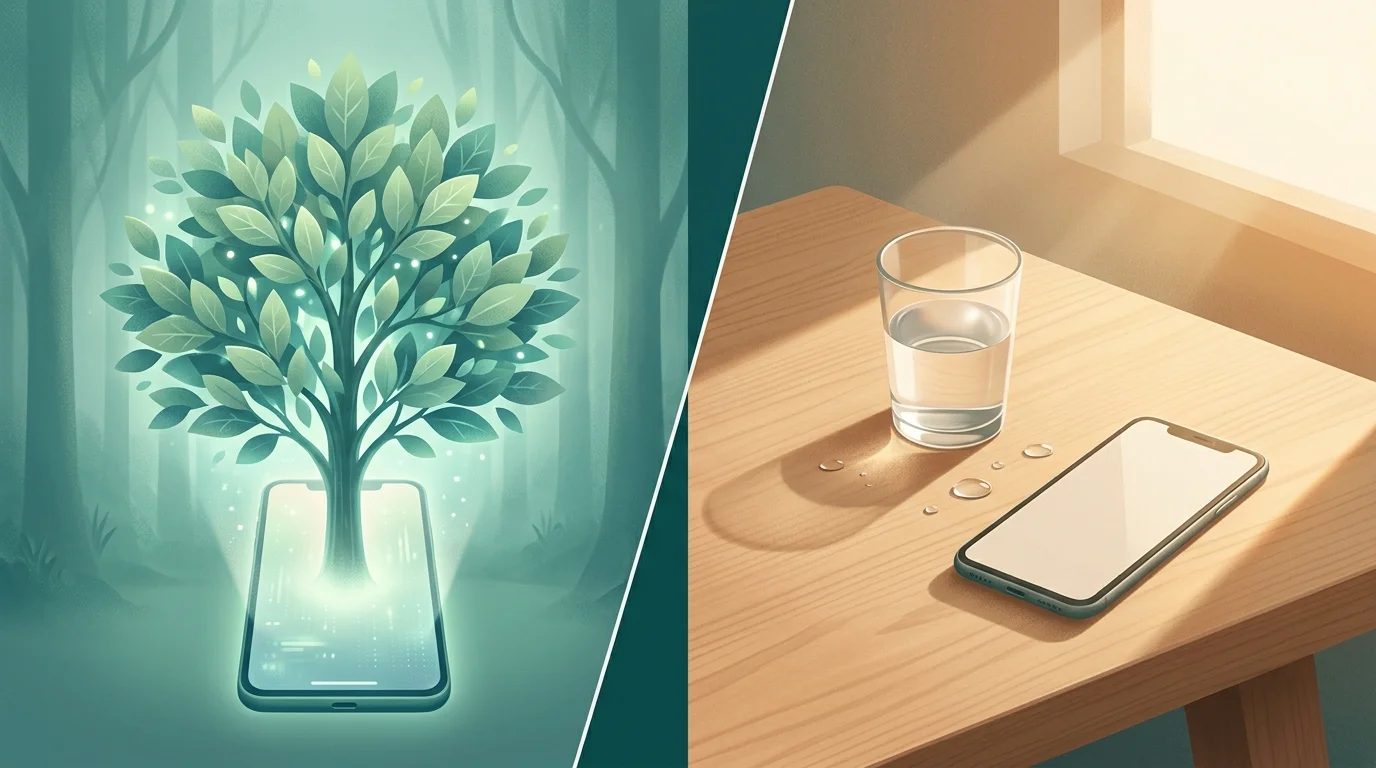
The task is open. The intention is there. But between deciding to focus and actually starting, there's a gap — a few seconds where nothing has happened yet. That gap has a gravitational pull. Before the thought has finished forming, the thumb is already moving, the feed is already open, and a minute has become five. You close it. You open a focus timer instead. A small tree begins growing on your screen. This time you'll stay. Twenty minutes in, you glance at one notification. The tree dies. You're still distracted — just guilty now too.
Both Forest and Sip & Scroll are built for that gap. But they approach it from entirely different directions. Forest is gamification: stay off your phone during a timer session, and a virtual tree grows. Leave, and it dies. Sip & Scroll is gentle friction: a short physical ritual — a sip of water and a quick selfie — that stands between you and any automatic app opening, followed by 45 minutes of fully intentional access. One tries to make focus rewarding. The other makes distraction slightly harder to start.
Which approach actually works depends on what kind of phone problem you have — and that distinction is worth spending a few minutes on before you download anything.
What Is the Forest App?
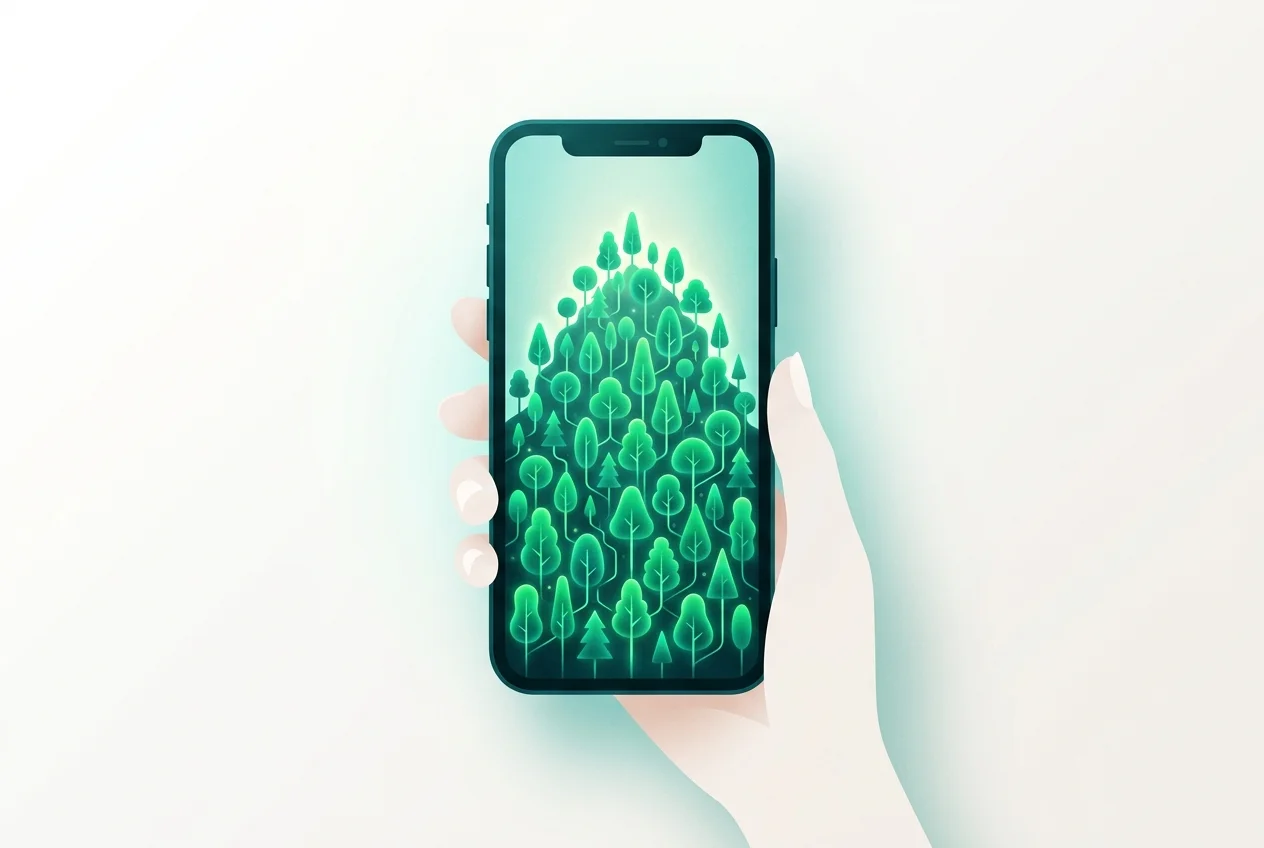
Launched in 2014 by Seekrtech, Forest has become one of the most downloaded productivity apps on the App Store — and it works by making you want to stay focused rather than forcing you to. The core mechanic is simple: set a timer (typically 25 minutes, Pomodoro-style), and a small tree begins to grow on your screen. If you stay in the app until the timer ends, the tree is added to your virtual forest. Leave to check Instagram, scroll a feed, or do anything else — the tree dies.
It's a deceptively well-designed loop. You're not locked out of anything. There's no punishment, no alarm, no lecture. But the dying tree activates something real: loss aversion, the psychological tendency to feel the pain of losing something more acutely than the pleasure of gaining something equivalent. Behavioral economists have found that losses feel roughly twice as powerful as equivalent gains. Forest turns your focus session into something worth protecting.
There's also a real-world component. Premium coins earned during sessions can be redeemed to plant actual trees through a partnership with the Trees for the Future organization — a touch that gives the gamification genuine meaning beyond personal streaks. Forest's premium version unlocks additional tree species, deeper usage stats, and a couple of hundred real trees planted so far at scale across its global user base.
The limitation: Forest solves a specific problem — the one where you've already decided to work and need help staying on task during a scheduled session. It doesn't address the other problem: the fifty impulsive phone checks that happen between sessions. The reflexive morning reach before you've had a conscious thought. The Instagram open while waiting for your coffee to brew. Those moments happen when no timer is running, no tree is growing, and your apps are just as frictionless as always.
How Sip & Scroll Takes a Different Approach
Sip & Scroll was designed for a different moment — not the focus session you planned, but the reflex you didn't. The split second before a feed opens, when there was no decision, just a motion your hand has made ten thousand times.
Here's how it works: you select the apps you want to add friction to — TikTok, Instagram, YouTube, whatever pulls you in without permission. When you open one of those apps, instead of landing in the feed, you're prompted to complete a short ritual: take a sip of water and snap a quick selfie confirming it. That's the whole gate. No quiz, no punishment, no lecture. After the ritual, you get up to 45 minutes of completely unblocked access. When the session ends, the gate resets — another sip to continue, or you stop.
The mechanism works differently from gamification. It doesn't ask you to care about a streak or a visual reward. It inserts a brief physical pause into an otherwise automatic loop. Dopamine-driven habits are reflexive by design — they fire before the prefrontal cortex (the part of your brain that weighs consequences) even registers what's happening. The water ritual is just long enough to give that slower, deliberate part of your brain a chance to catch up. Sometimes you scroll anyway, and that's fine. You did it on purpose this time.
Sip & Scroll is free to download. There's no virtual currency, no streak to protect, no dead tree to feel guilty about. It's architecture, not motivation — and the difference between those two things turns out to matter quite a lot.
Why Gamification Isn't Always Enough

Gamification works best when motivation is already present and the novelty is still fresh. Give someone a goal they care about, add visible progress, and they'll often follow through. Forest is excellent at this during the sessions it covers.
But motivation-dependent systems have a ceiling. The novelty of the growing tree fades over weeks. A stressful day makes the virtual forest feel irrelevant against real problems. You kill one tree impulsively and the streak is broken — so you might as well keep scrolling. Behavioral scientists call this the abstinence violation effect: once you've broken a streak or rule, the psychological pressure holding the behavior in place collapses. The reasoning becomes "I've already failed today, so why stop?" The all-or-nothing framing turns a single lapse into a full session. It's one of the core reasons gamified screen time apps tend to produce short bursts of improvement rather than lasting behavioral change.
The deeper limitation is about scope. Forest covers the moments when you actively start a timer. Everything outside those windows — the margins, the waiting, the in-between — is uncovered. And that's where most people's excess phone use actually lives. Research on smartphone behavior consistently finds that the majority of phone sessions are short, unplanned, and automatic: less than two minutes, triggered by boredom or proximity rather than intention. Forest doesn't touch any of that.
Gentle friction sidesteps the motivation problem because it doesn't require any. Behavioral designer BJ Fogg's research on behavior change shows that reducing friction — or in this case, adding just enough friction to interrupt an automatic behavior — is among the most reliable interventions available. Not because it stops you, but because it creates a moment of choice where there wasn't one before. The water ritual doesn't make you want to scroll less. It just asks you to notice what you're doing before you do it. That noticing, it turns out, is often enough.
Forest vs. Sip & Scroll: Head-to-Head
These two apps serve different users at different moments in the phone-use cycle. Here's a direct comparison across the dimensions that matter most:
What problem it solves
Forest addresses the focus-session problem: you've decided to work, and you need reinforcement to stay on task while the timer runs. It's proactive — you start a session with intention. Sip & Scroll addresses the impulsive-opening problem: the apps you open without deciding to, the reflex checks that happen dozens of times a day in the margins of your life.
How it works psychologically
Forest uses gamification — positive reinforcement from a growing forest combined with loss aversion from the dying tree. It's motivation-first. Your engagement with the game mechanic determines whether it works. Sip & Scroll uses gentle friction — a small physical cost inserted at the exact moment the impulse fires. It's architecture-first. Your motivation level on any given day doesn't change how the gate works.
Cost
Forest is free to download with a paid premium tier for additional features (approximately $3.99 for the full version, with some subscription options for premium features). Sip & Scroll is free to download.
Best for
Forest works best for students, developers, writers, and anyone who responds to visual progress metrics, streaks, and gamified goals during deliberate work periods. Sip & Scroll works best for anyone who opens social apps on autopilot — who finds hard locks frustrating or infantilizing, and who wants to scroll intentionally rather than reflexively without giving up access entirely.
Which One Should You Download?
If your main struggle is staying on task during work sessions you've already planned — Forest is a genuinely well-crafted app for that problem. It's thoughtfully designed, the loss-aversion mechanic is real, and the tree-planting donation feature gives the streaks meaning beyond a personal statistic. If visual goals and gamified progress actually motivate you to stay focused during structured work periods, it's worth the small one-time cost.
If your main struggle is the impulsive opens — the quick checks, the reflex scrolls, the fifteen minutes that vanish before you notice them starting — Forest won't touch that. The timer only runs when you start it. The rest of the day, every app opens as freely and automatically as always. The reflex that got you here isn't addressed.
That's the gap Sip & Scroll fills. It doesn't care whether you're in a work session or a waiting room or lying in bed at midnight. Every time an app in your tracked list is opened, the gate appears: take a sip, or don't open it. Most people find this less frustrating than a hard block and more reliable than willpower — not because it stops you, but because it gives you back the split second to decide. You still scroll. You just have to choose to scroll, which is exactly the kind of friction that the attention economy was engineered to remove.
The good news: you don't have to choose between them. Forest handles deliberate focus sessions. Sip & Scroll handles everything else. Together, they cover the full phone-use cycle — the scheduled blocks and the impulsive margins between them — which is coverage neither app can provide alone. If you want a deeper look at how Sip & Scroll stacks up across the full field of iPhone app blockers, the comparison is worth reading before you decide.
The core problem isn't that you lack willpower or discipline. It's that the apps pulling at your attention were designed by teams of engineers and behavioral scientists whose only job is to capture and hold that attention — for as long as possible, as automatically as possible. You cannot out-willpower a system built to override your prefrontal cortex. What you can do is introduce structural friction at the moment it matters: the split second before the feed opens, when there's still a choice to be made. That's what Sip & Scroll gives you back.
Turn the reflex into a ritual.
A sip of water before every scroll. 45 minutes of intentional access. No hard locks, no guilt — just a pause that gives you back the choice.
Download Sip & Scroll — Free